
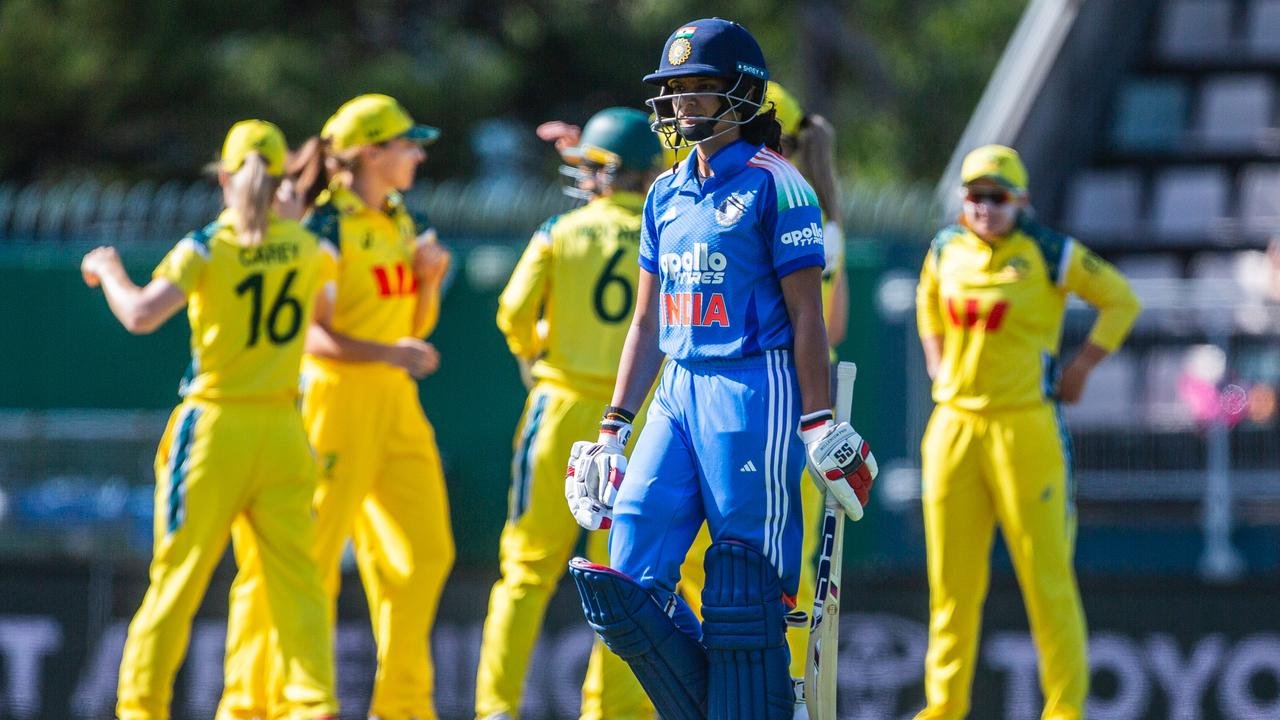
The Indian women’s team suffered a severe 185-run defeat against AUS during their third ODI match at Hobart. The result confirmed a 3–0 series whitewash in the 50-over format. Australian players outperformed Indian players throughout the match because the visitors failed to match their home team’s intensity.
Australia controlled the match from the first innings. Their batting dominance created scoreboard pressure early. India never managed to regain balance after that phase.
Australia’s Batting Masterclass Sets the Platform
Australia chose to bat first and utilised the Bellerive Oval conditions to their maximum advantage. The ball delivered an accurate bounce, which allowed batters to build their confidence. Their playing style mixed destructive play with disciplined execution.
She finished her international cricket career through her final match which she scored 158 runs from 98 balls to help her team win the game. Healy demonstrated her attacking playing style at the start of the match by using different methods to hit boundaries while she maintained her batting position.
Phoebe Litchfield was by her side during the early stages, helping the Australian side settle. Once Georgia Voll joined the crease, the momentum continued to build. Her 62 ensured that the pace was not slowed down during the middle overs.
The turning point came through the association between Healy and Beth Mooney. Their 145-run stand helped increase the run rate. Mooney’s unbeaten 106 ensured that the Australian side ended the innings well.
It was a turning point, and the scoreboard was a giant factor for the Australian side.
India’s Chase Struggles Under Pressure
Chasing 410 runs was going to demand a great and steady start. But India lost Smriti Mandhana early on. This gave Australia the much-needed momentum.
Pratika Rawal and Jemimah Rodrigues tried their best to steady the ship. They rotated the strike and found boundaries at times. But none of them stayed on to provide solidity to the Indian team.
The required run rate escalated throughout the match as time and overs progressed. The middle overs proved difficult for India to sustain their scoring efficiency. The situation compelled them to pursue dangerous plays, which resulted in their wicket losses.
Deepti Sharma and Sneh Rana tried to stem the damage and reduce the equation. They displayed great resistance and calmness in a tricky situation. But the runs were still too far away.
Key Performance And Turning Points
Healy and Mooney’s Game-Changing Partnership
Healy’s 158 was the base on which the Australian side built their dominance. Healy attacked the bowlers early, and the Indian side never got the chance to settle.
Mooney provided perfect support to Healy because her aggressive playing style required an optimal backing partner. The 106 runs that Mooney scored without losing his wicket showed how to play cricket while remaining composed throughout the game. The two players maintained a constant level of performance throughout the match.
Early Wickets Hurt India’s Momentum
Mandhana’s early layoff put the team on the back foot. A strong partnership at the top was needed for the chase, and that was not to be. This set the tone for the last game.
Although the runs were scored by the duo of Rawal and Rodrigues, the dismissals never allowed the momentum to build.
Middle Overs Acceleration Proved Decisive
The middle overs from 20 to 40 in Australia’s innings were decisive. Instead of building on their innings, the hosts accelerated their rate. India was unable to break this partnership during this time.
Fielding Blunders Contributed to the Damage
India had a few half-chances during Australia’s innings. Some misfields led to the loss of runs. These are common in high-scoring matches.
These potential benefits were certainly not seized by India. Australia made the most of the chances they got.
Bowling Under Constant Pressure
India’s bowlers found it nearly impossible to cope when the partnership was established. This was because the variations of pace and length did not always trouble the established batsmen.
When the score was rising, defensive fields had to be put in chronological order. This reduced the chances of wicket-taking and enabled the Australians to finish strongly.
Looking Ahead
The upcoming one-off Test match in Perth will serve as the test venue for India to reorganise their team and discover a fresh understanding of the game. Teams face new strategic difficulties when they transition to different formats of play.
The single Test match against Australia will be played with confidence because Australia’s performance in the ODI series has proved their ability to win matches on their home grounds. The Hobart defeat will provide India with valuable knowledge that will assist its future growth.