
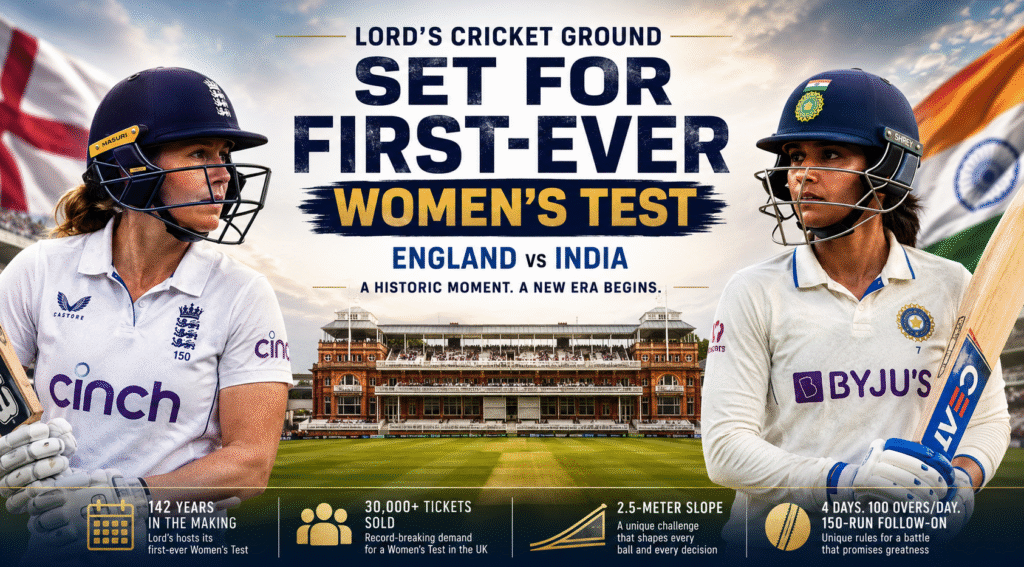
For over a century, the hallowed turf of St. John’s Wood has staged the ultimate skirmishes in red-ball cricket. Still, some sort of incredible milestone is finally creeping in this summer. Lord’s Cricket Ground is officially getting ready to host its first-ever women’s Test match, where a dominant England side will face up against a powerhouse India team.
This historic encounter feels like a monumental turn in the sport, because for decades, women cricketers were kind of pushed aside from the traditional longest format at the “Home of Cricket”. Now the whole world’s cricketing community is locked in, and everyone seems to be waiting for a real, edge-of-the-seat four-day contest on the world’s most legendary playing surface. If you want deeper pre-match statistics and fresh, modern cricket updates, you can follow the action on the Cricstrike Platform.
The Historical Significance of the First-Ever Women’s
The upcoming match is not just another fixture on the calendar; it is a profound cultural correction, you know. Lord’s Cricket Ground hosted its first men’s Test match way back in 1884 and it has taken an astonishing 142 years for the venue to finally grant the same Test match privileges to women.
That long wait, stems from deep strict , conservative traditions connected with the Marylebone Cricket Club (MCC) , the institutional custodian of the ground. Take a look at these structural facts that kind of sit underneath everything:
The Membership Barrier: Women were completely blocked from becoming voting MCC members until a monumental policy change in 1998.
The Pavilion Ban: Female spectators as well as professionals were legally limited from entering the prestigious Lord’s Pavilion during live play until 1999.
The Long Room Access: The legendary walk through the Long Room out onto the field was historically a male-only permission.
This summer’s match comes exactly 50 years after the trailblazing Rachael Heyhoe Flint took an England women’s team out at the ground for a landmark One-Day International in 1976. So, when today’s players slip through the Grace Gates, they are basically carrying on something built by women who had to push back just to get the chance to wear cricket whites. And when England captain Nat Sciver-Brunt and Indian skipper Harmanpreet Kaur step down the Pavilion stairs, they’ll be setting up a fresh, new chapter around equality in sports, not only turning another page.
Why Lord’s Cricket Ground is the Ultimate Stage
There’s just an undeniable kind of magic tied to playing at Lord’s Cricket Ground. The peculiar 2.5-meter slope that runs across the playing field, from north to south, somehow makes very clear tactical bends and differences, enough to trip up even the smartest tactical minds.
And as the structural updates on the Cricstrike Platform emphasize, dealing with the Lord’s slope really is an art form for swing and seam bowlers. For international teams, getting to grips with that terrain feels like the ultimate badge of honor, even if it sounds a bit dramatic. Then there’s the ticket demand, which has jumped exponentially , more than 30,000 seats already locked in across the planned four days of play , and it’s effectively smashed the prior UK domestic record for a women’s Test gate.
To underline how big this is, the ground will double down on its commitment to the modern women’s game. It’s scheduled a record 21 major women’s fixtures for the 2026 season. This pushy scheduling shift more than doubles the audience capacity that was set aside in earlier years, pointing to a booming consumer market, honestly.
Tactical Breakdown: England vs India Form Guide
This red-ball showdown kind of features two styles of play that are almost fully opposite. India lands on English soil with serious red-ball momentum with them. The visitors pretty much took control of England in their last meeting in Navi Mumbai, and they sealed a solid 347-run win, not playing around.
On the numbers side, India have a truly strong record when they travel to the United Kingdom. They’ve stayed unbeaten in their last nine women’s Test matches in England, with two wins and seven closely fought draws.
England though, leans on a very seasoned spine. The iconic Tammy Beaumont is expected to turn this storied occasion at Lord’s Cricket Ground into a proper send off, basically marking the end of her 17-year international spell. Beaumont is also the first English woman to score a personal Test double-century, which she managed at Trent Bridge. On top of that, with Heather Knight’s tactical smarts and Nat Sciver-Brunt’s explosive thrusts, England’s top order looks like a tough, stubborn wall. Full squad tracking , plus injury updates are available through the Cricstrike Platform, so people can follow along closely.
Unpacking the Unique Rules of Women’s Test Cricket
While men’s Test matches are usually played out across five structural days, women’s Test matches run on a tightly compressed four day plan. That difference kind of forces a distinct set of rules, so the contest stays even , competitive and not one sided in weird ways.
- Daily Over Requirement: 100 Overs Minimum.
Where men’s red-ball cricket typically asks for 90 overs each day, the women’s Test setup requires at least 100 overs per day. The idea is basically to balance out that shorter four day stretch, and keep results meaningful.
- Follow-On Margin: 150 Runs Target.
In a normal five-day Test, a captain may set a follow-on when the other team is behind by 200 runs. But in this Lord’s four-day arrangement , the follow-on trigger is lowered to 150 runs.
- Optimal Ball Composition: 5.5 Ounces Standard.
The game uses a particular red cricket ball, weighed to sit roughly between 4.94 and 5.31 ounces. It’s slightly smaller and lighter than the men’s version, and it is built to help aerodynamic movement , plus a faster high-velocity release.
Conclusion: A Landmark Leap for the Global Game
The arrival of the first ever women’s Test at Lord’s Cricket Ground is like a defining win for sports equality, kind of a bridging of a long historical gap, and yes it also makes clear just how much skill there is in elite women’s red-ball cricket. It brings together validation and immense talent, even the big draw that everyone can now see. When the usual five-minute bell rings to start the first morning, it feels like an emotional triumph for every woman who was once kept out, from that iconic Pavilion.
Key Takeaways
- Historical Milestone: Lord’s Cricket Ground breaks a 142-year drought by staging its first-ever women’s Test match.
- Heavy Ticket Demand: Over 30,000 tickets have been sold, setting a historic UK attendance milestone for women’s red-ball cricket.
- Unique Conditions: Teams must navigate the distinct 2.5-meter slope running across the playing area.
- Format Variances: The match is a four-day battle requiring a minimum of 100 overs bowled daily with a 150-run follow-on limit.
FAQs
1. Why has it taken so long for Lord’s Cricket Ground to host a women’s Test?
The delay was primarily due to the deeply entrenched male-only traditions of the Marylebone Cricket Club (MCC). Women were officially denied general club membership until 1998 and were entirely restricted from entering the Lord’s Pavilion during active play until 1999.
2. How many days are scheduled for the women’s Test match?
The match is scheduled to run over four days instead of five. To compensate for the shorter duration, broadcasting guidelines mandate a minimum of 100 overs to be bowled each day rather than the traditional 90.
3. What is India’s head-to-head red-ball record against England?
India holds an incredibly strong red-ball record in the UK. They are currently unbeaten across their last nine women’s Test matches played on English soil, securing two wins and seven hard-fought draws.
4. Who will ring the famous five-minute bell for this match?
To celebrate this historic event, the MCC has invited 50 former England women cricketers to collectively commemorate the opening of the match, with selected legends ringing the historic bell.
5. Where can I find real-time squad statistics and analytics for this match?
You can find exhaustive statistical breakdowns, performance metrics, and live match coverage on dedicated sports tracking ecosystems like the Cricstrike Platform.