
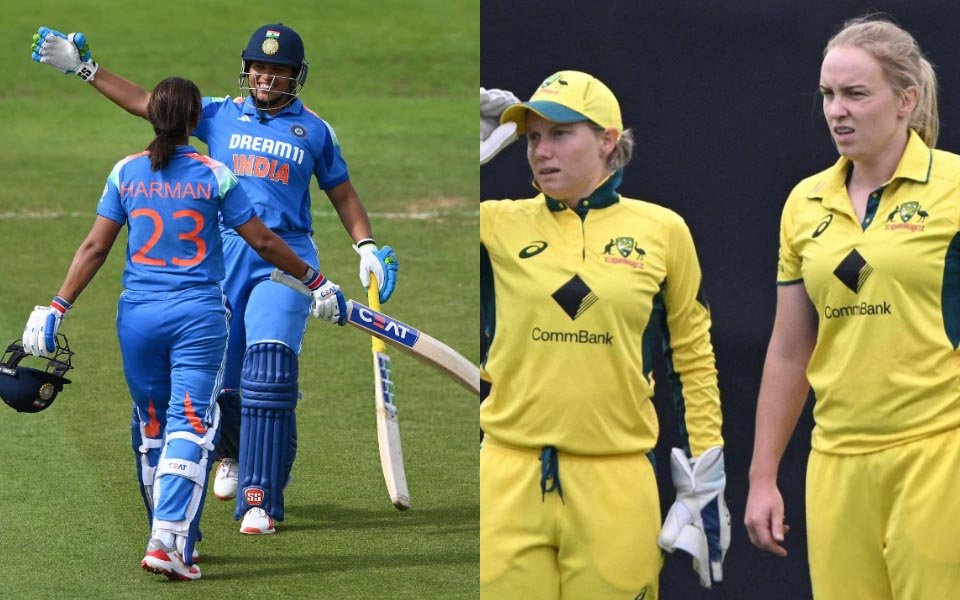
Australia established a dominant position in the women’s multi-format series after their successful chase of India’s 251 during the second ODI at Bellerive Oval. All the while, hosts applied pressure schematically as they established companionship to reduce the claim and dictate game dynamics toward their side.
India had earlier compiled 251 for 9 after choosing to bat, with captain Harmanpreet Kaur and opener Pratika Rawal scoring half-centuries.
The Australian chase showed that the total became inadequate because the pitch provided constant bounce and benefited players who attempted to make shots.
India’s Competitive Total Built Around Two Fifties
Rawal and Mandhana Provide Early Stability in ODI
India started their batting with controlled play instead of playing aggressively. The opening partnership between Rawal and Smriti Mandhana established a stable batting partnership which protected their wickets during the powerplay. Their approach focused on placement and rotation rather than risk.
The foundation established by India allowed them to enter the middle overs with a stable position when Rawal reached her half-century.
Middle-Order Stumble Limits Acceleration
India lost its momentum because early wickets fell in rapid succession. A brief collapse disrupted momentum and prevented the innings from expanding toward a 270-plus total.
Harmanpreet Kaur performed the innings recovery through her controlled batting, which produced a 54-run score to help India reach a defendable match total.
The total depends on the bowlers’ ability to maintain pressure, but this task became challenging when Australia started their run chase.
Australia’s Chase Driven by Youthful Authority
The Australian team launched their batting mission when they began their response to the match. Phoebe Litchfield started her innings successfully by hitting boundaries through the square field area, which made India bowlers change their bowling lengths.
Her 80 from 62 balls combined controlled placement with aggressive timing, allowing Australia to keep ahead of the required rate.
Litchfield maintained her control over scoring areas, which led to a constant batting pace after captain Alyssa Healy lost her wicket early in the match.
The initial pace which Litchfield established was transformed into complete control by Georgia Voll. After she reached her initial performance level, she increased her speed to use her drives and lofted strokes for the complete destruction of India’s spin bowling.
Her century validated the chase while it eliminated all remaining pressure which could have affected the match. Australia needed only to complete basic tasks after Litchfield left because they had already achieved their target.
India’s Bowling Struggles in the Middle Overs
Missed Chances and Loose Lines
The Indian bowlers did not manage to control the batting partnership after it entered its initial phase. The bowlers did not get a second chance to put pressure on the batsmen as they did not catch two chances and bowled two inconsistent balls.
Voll was able to escape a crucial catch attempt, which would have changed the course of the match. The batting partnership between the two players was developing at a fast rate.
The Australian batters did not offer any more chances for the Australian batsmen to develop their second attack.
Spin Unable to Control Run Flow
Litchfield and Voll both used their footwork skills to counter the spin delivery and hit the ball into open areas.
Australia gained complete control over their batting after it succeeded in allowing its opponents to score without restrictions. The match required run rate decreased because the team could not build pressure through their boundary deliveries.
Why the Chase Looked Comfortable
Australia followed a controlled pattern during their chase because one player attacked while the second player defended. The two players maintained constant pressure because they switched between different playing styles.
India lost most of their strategic choices after both batters established their presence at the crease. Defensive fields created easy opportunities for singles, while attacking fields let batters hit the ball for boundaries.
Another factor was the depth of the Australian team. With Mooney and Sutherland to come, the early fall of wickets was not going to worry the team too much.
This was the reason Litchfield and Voll were able to play freely.
Key Takeaways From the Match
India showed disciplined batting performance which failed to generate runs during crucial middle overs of the match. The team needed to defend 251 runs because the pitch required bowlers to deliver exceptional performances.
The team required early wickets and better spin control to reach their target which became unachievable as time passed.
The Australian team used a combination of patient play and aggressive strategy to achieve their victory. Litchfield’s initial runs scored relieved the pressure on the scoreboard while Voll’s century maintained the team’s scoring momentum.
The team balances itself through ODI pacing because its players possess both experience and extensive skill sets. If you are looking for more cricket news then Cricstrike is the beast place to start. Visit the site today.